 |
 |
 |
 |
 |
— share —





Net flux
Definition:
Net flux represents the amount of substance moved in or out of the cell. It is the mathematical difference between influx and efflux.Net flux = Influx − Efflux
Similar to influx and efflux, net flux is reported as a rate. It is the net amount of substance that moves through a given area of the plasma membrane per unit time.
Related glossary terms/phrases:
FluxInflux
Efflux
Unidirectional flux
Electrochemical driving force
Abbreviation:
VDFDefinition:
When an ion is not at its electrochemical equilibrium, an electrochemical driving force (VDF) acts on the ion, causing the net movement of the ion across the membrane down its own electrochemical gradient.The electrochemical driving force is generally expressed in millivolts and is calculated according the following equation:
VDF = Vm − Veq
where VDF is the electrochemical driving force, Vm is the membrane potential, and Veq is the equilibrium potential.
Related glossary terms/phrases:
Membrane potentialEquilibrium potential
Electrochemical gradient
See also:
Resting Membrane Potential - Electrochemical Driving Force Acting on IonsElectrochemical Driving Force Calculator
Electrogenic pump
Definition:
Electrogenic pumps are primary active transporters that hydrolyze ATP and use the energy released from ATP hydrolysis to transport ions across biological membranes leading to the translocation of net charge across the membrane.For example, the Na+/K+ ATPase (sodium pump) is an electrogenic pump because during every transport cycle, it transports 3 Na+ ions out of the cell and 2 K+ ions into the cell. This leads to the movement of one net positive charge out of the cell making this process electrogenic.
Related glossary terms/phrases:
ElectrogenicElectrogenic
Definition:
An electrogenic transport process is one that leads to the translocation of net charge across the membrane. For example, ion channels such as Na+, K+, Ca2+, and Cl− channels are electrogenic.The Na+/K+ ATPase is electrogenic because for every ATP molecule hydrolyzed, 3 Na+ ions are transported out of the cell and 2 K+ ions are transported into the cell (leading to the translocation of one net positive charge out of the cell).
Many secondary active transporters are also electrogenic. For example, the Na+/glucose cotransporter (found in the small intestine and kidney proximal tubules), transports 2 Na+ ions and 1 glucose molecule into the cell across the plasma membrane (leading to the translocation of two net positive charges into the cell per transport cycle).
Equilibrium potential
Abbreviation:
Veq. or Eeq.Definition:
Refers to the membrane potential at which there is no net movement of an ion across the plasma membrane into or out of the cell.See also:
Resting Membrane Potential - Establishment of the Membrane PotentialResting Membrane Potential - Nernst Equilibrium Potential
Nernst Potential Calculator
Glutamate
Definition:
Glutamate (Glu, E) is one of the standard twenty (20) amino acids used by cells to synthesize peptides, polypeptides, and proteins. It has a molecular weight of 147.13 g/mol. Its side chain has a pKa of 4.07 and, therefore, glutamate has a net negative charge at physiological pH.In the nervous system, glutamate is an excitatory amino acid neurotransmitter. In fact, glutamate is the most abundant excitatory neurotransmitter in the nervous system. Glutamate is a classical neurotransmitter. Its action is exerted via the activation of glutamate receptors (GluR), some of which are ligand-gated ion channels (ionotropic receptors), and some are G protein coupled receptors (GPCRs, metabotropic receptors). At glutamatergic synapses, the action of glutamate is terminated by glutamate transporters (EAAT, excitatory amino acid transporter), which transport glutamate from the extracellular space in synaptic and extrasynaptic regions into neurons and glia.
Impermeant
Definition:
Not permeant. Incapable of passing through or penetrating. Impermeant refers to the inability of a substance (e.g., ion or molecule) to cross (i.e., permeate or penetrate) a biological membrane or channel pore. For example, it can be said that ions are membrane impermeant.See also permeant.
Related glossary terms/phrases:
PermeantPermeability
Permeable
Impermeable
See also:
Lipid Bilayer PermeabilityNernst equation
Definition:
An equation used to calculate the equilibrium potential (Veq.) of an ion. The equilibrium potential for an ion is also referred to as the Nernst potential for that ion. It is the membrane potential at which no net movement of the ion in question occurs across the membrane.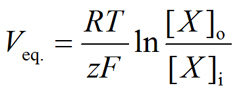
where Veq. is the equilibrium potential, R is the universal gas constant, T is the temperature in Kelvin, z is the valence of the ionic species, F is the Faraday's constant, and [X]o and [X]i are the extracellular and intracellular, respectively, concentrations of the ion in question.
See also:
Resting Membrane Potential - Nernst Equilibrium PotentialDerivation of the Nernst Equation
Permeant
Definition:
Permeant refers to the ability of a substance (e.g., ion or molecule) to cross (i.e., permeate or penetrate) a biological membrane or channel pore. For example, it can be said that fat-soluble molecules are membrane permeant.See also impermeant.
Related glossary terms/phrases:
ImpermeantPermeability
Permeable
Impermeable
See also:
Lipid Bilayer PermeabilityUnidirectional flux
Definition:
The rate of movement of a substance across an interface in only one, and not the opposite, direction (i.e., flux in only one direction). For example, when referring to the plasma membrane of cells, we can think of unidirectional flux of a substance ino the cell (referred to as influx), as well as unidirectional flux of the substance out of the cell (referred to as efflux). The difference between two unidirectional fluxes is referred to as net flux, which is the net amount that moves into or out of the cell.Related glossary terms/phrases:
FluxInflux
Efflux
Net flux
Posted: Sunday, March 31, 2013
Last updated: Wednesday, March 12, 2025
Last updated: Wednesday, March 12, 2025
— share —