 |
 |
 |
 |
 |
— share —


Adrenarche
Definition:
An early sexual maturation stage, occurring 1 or 2 years before the onset of puberty, during which the zona reticularis of the adrenal cortex releases increased levels of dehydroepiandrosterone (DHEA) and androstenedione. These adrenal androgens are ultimately responsible for the appearance of pubic and axillary hair, increased oil production by facial skin, acne, and distinct adult body odor.Related glossary terms/phrases:
MenarchePubarche
Thelarche
Autoregulation
Definition:
The ability of a tissue or organ to regulate its own function without extrinsic neural or hormonal input.For example, in the kidneys, autoregulation ensures relatively constant blood flow and pressure through the kidney tubules in order to maintain a fairly constant glomerular filtration rate (GFR).
Calcium
Abbreviation:
Ca2+Definition:
Calcium (Ca2+) is a divalent cation. It plays an important role in physiological processes such as muscle contraction and synaptic transmission. Calcium is also an intracellular messenger.The extracellular concentration of Ca2+ is about 2 mM. The intracellular concentration of Ca2+ is about 70 nM.
Chemical gradient
Definition:
Refers to the concentration gradient of an ion or molecule. The concentration gradient may exist across a biological membrane, where the concentration is higher on one side of the membrane compared to the other side. Concentration gradient may also exist in a solution without an apparent barrier separating the area of higher concentration from the area of lower concentration. In both cases, the free energy that results from the concentration difference drives the movement of the ion/molcule from the area of higher concentration to the area of lower concentration. In free solution, the ion/molecule simply diffuses down its gradient. Movement across a biological membrane is more complicated and is a function of lipid solubility of the ion/molecule as well as the presence of channels or transport proteins that can allow the ion/molecule to cross the membrane (see Lipid Bilayer Permeability and Summary of Membrane Transport Processes).Related glossary terms/phrases:
Electrical gradientElectrochemical gradient
Chloride
Abbreviation:
CI−Definition:
The main anion (negatively charged ion) of the extracellular fluid.Cloride (Cl−) plays an important role in several physiological processes such as the action potential of skeletal muscle cells, CO2 transport in blood (via Cl−/bicarbonate exchange across the plasma membrane of red blood cells), and many other processes.
The extracellular concentration of Cl− is about 110 mM. The intracellular concentration of Cl− is about 10 mM.
Cotransport
Definition:
A type of secondary active transport across a biological membrane in which a transport protein couples the movement of an ion (usually Na+ or H+) down its electrochemical gradient to the movement of another ion or molecule against a concentration or electrochemical gradient. The ion moving down its electrochemical gradient is referred to as the driving ion. The ion/molecule being transported against a chemical or electrochemical gradient is referred to as the driven ion/molecule.In cotransport, the direction of transport is the same for both the driving ion and driven ion/molecule (into the cell or out of the cell).
An example is the Na+/glucose cotransporter (SGLT), which couples the movement of Na+ into the cell down its electrochemical gradient to the movement of glucose into the cell against its concentration gradient.
Cotransport is also commonly referred to as symport.
Transport proteins that are involved in this type of transport are referred to as cotransporters or symporters.
See:
SymportRelated glossary terms/phrases:
Secondary active transportExchange
See also:
Lecture notes on Secondary Active TransportExchange
Definition:
A type of secondary active transport across a biological membrane in which a transport protein couples the movement of an ion (usually Na+ or H+) down its electrochemical gradient to the movement of another ion or molecule against a concentration or electrochemical gradient. The ion moving down its electrochemical gradient is referred to as the driving ion. The ion/molecule being transported against a chemical or electrochemical gradient is referred to as the driven ion/molecule.In exchange, the driving ion and the driven ion/molecule are transported across the biological membrane in opposite directions.
An example is the Na+/Ca2+ exchanger (NCX), which couples the movement of 3 Na+ ions into the cell down its electrochemical gradient to the movement of 1 Ca2+ ion out of the cell against its electrochemical gradient.
Exchange is also commonly referred to as antiport.
Transport proteins that are involved in this type of transport are referred to as exchangers or antiporters.
See:
AntiportRelated glossary terms/phrases:
Secondary active transportCotransport
See also:
Lecture notes on Secondary Active TransportExcitable cell
Definition:
Refers to the ability of some cells to be electrically excited resulting in the generation of action potentials. Neurons, muscle cells (skeletal, cardiac, and smooth), and some endocrine cells (e.g., insulin-releasing pancreatic β cells) are excitable cells.See also:
Resting Membrane Potential - IntroductionFacilitated diffusion
Definition:
Facilitated diffusion (or facilitated transport) is a form of passive transport across biological membranes and refers to carrier-mediated transport of molecules/ions down a concentration gradient. Facilitated transport is mediated by facilitative transporters (also referred to as uniporters).See also:
Facilitated DiffusionHypercalcemia
Definition:
A total plasma calcium level that is greater than the normal range of 2.2 - 2.6 mM (9 - 10.5 mg/dL). The free calcium concentration in the plasma is approximately 1.5 mM (6 mg/dL), and the remaining amount is bound to plasma proteins.Related glossary terms/phrases:
HypocalcemiaHyperglycemia
Definition:
Condition in which the plasma glucose concentration is abnormally high. In general, a fasting plasma glucose concentration higher than 110 mg/dL, or a postprandial plasma glucose concentration higher than 180 mg/dL is considered abnormally high.Normal, fasting glucose concentrations range from 70 to 110 mg/dL.
Related glossary terms/phrases:
HyperglycemicHypoglycemia
Hypoglycemic
Hyperglycemic
Definition:
Related to, or pertaining to hyperglycemia.An agent that causes an increase in plasma glucose concentration (i.e., induces hyperglycemia).
Related glossary terms/phrases:
HyperglycemiaHypoglycemia
Hypoglycemic
Hypocalcemia
Definition:
A total plasma calcium level that is less than the normal range of 2.2 - 2.6 mM (9 - 10.5 mg/dL). The free calcium concentration in the plasma is approximately 1.5 mM (6 mg/dL), and the remaining amount is bound to plasma proteins.Related glossary terms/phrases:
HypercalcemiaHypoglycemia
Definition:
Condition in which the plasma glucose concentration is abnormally low. In general, a plasma glucose concentration lower than 70 mg/dL is considered abnormally low.Normal, fasting glucose concentrations range from 70 to 110 mg/dL.
Related glossary terms/phrases:
HypoglycemicHyperglycemia
Hyperglycemic
Hypoglycemic
Definition:
Related to, or pertaining to hypoglycemia.An agent that causes a reduction in plasma glucose concentration (i.e., induces hypoglycemia).
Related glossary terms/phrases:
HypoglycemiaHyperglycemia
Hyperglycemic
Iodide trap
Definition:
Refers to the ability of the thyroid gland to accumulate iodide (I−) against a steep electrochemical gradient. While the iodide concentration in plasma and interstitial fluid is approximately 300 nL, iodide concentration in the cytoplasm of thyroid follicular cells, as well as the lumen of thyroid follicles can be many folds higher. The protein that enables iodide transport into the thyroid gland against an electrochemical gradient is the Na+/iodide symporter (NIS), which is located in the basolateral membrane of thyroid follicular cells. Within the lumen of thyroid follicles, iodide is incorporated into the tyrosine residues of thyroglobulin during thyroid hormone biosynthesis, hence, allowing very high iodide concentrations in the colloid.Korotkoff sounds
Definition:
The tapping sounds heard through a stethoscope placed over a partially compressed peripheral artery.For the purpose of non-invasive blood pressure measurements, the stethoscope is usually placed on the skin overlying the brachial artery just distal to an inflated pressure cuff wrapped around the upper arm. As the pressure cuff is gradually deflated, the Korotkoff sounds result from the pulsations of the blood through the partially constricted brachial artery. With each ventricular systole, blood is forced to flow through the partially constricted brachial artery, and the turbulence in blood flow leads to the generation of the Korotkoff sounds. When the pressure cuff is fully deflated, flow through the artery resumes its normal laminar flow and, at that time, the Korotkoff sounds disappear.
Nernst equation
Definition:
An equation used to calculate the equilibrium potential (Veq.) of an ion. The equilibrium potential for an ion is also referred to as the Nernst potential for that ion. It is the membrane potential at which no net movement of the ion in question occurs across the membrane.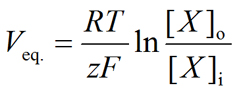
where Veq. is the equilibrium potential, R is the universal gas constant, T is the temperature in Kelvin, z is the valence of the ionic species, F is the Faraday's constant, and [X]o and [X]i are the extracellular and intracellular, respectively, concentrations of the ion in question.
See also:
Resting Membrane Potential - Nernst Equilibrium PotentialDerivation of the Nernst Equation
Otoacoustic emissions
Abbreviation:
OAEsDefinition:
Otoacoustic emissions (OAE) are sounds that arise from the organ of Corti within the cochlea of the inner ear in response to sound stimulation. They are thought to result from vibrations of cochlear outer hair cells (OHC) in response to stimulation by sound. Otoacoustic emissions are inaudible to the human ear, but can be recorded by placing a small recording device in the external auditory meatus (ear canal).Otoacoustic emissions have clinical diagnostic value and are measured as part of hearing exams. In the newborn, otoacoustic emissions are recorded in order to detect blockage in the middle ear cavity (e.g., as a result of fluid accumulation) or external ear canal.
Potassium
Abbreviation:
K+Definition:
The main cation (positively charged ion) of the intracellular fluid.Potassium (K+) plays an important role in the action potential of neurons and muscle cells.
The extracellular concentration of K+ is about 4 mM. The intracellular concentration of K+ is about 150 mM.
Prolactin
Definition:
Peptide hormone produced by the anterior pituitary gland. Prolactin is best known for its action in stimulating the mammary glands to produce milk (lactation).Prolactin is known to be involved in many other physiological processes including enlargement of the mammary glands in preparation for milk production, sexual gratification, metabolism, regulation of the immune system, and others.
Other resources:
Prolactin (Wikipedia)Secondary active transport
Definition:
Secondary active transport is a type of active transport across a biological membrane in which a transport protein couples the movement of an ion (typically Na+ or H+) down its electrochemical gradient to the movement of another ion or molecule against a concentration or electrochemical gradient. The ion moving down its electrochemical gradient is referred to as the driving ion. The ion/molecule being transported against a chemical or electrochemical gradient is referred to as the driven ion/molecule.This transport process is referred to as active transport because the driven ion/molecule is transported against a concentration or electrochemical gradient. It is referred to as secondary active transport because no ATP hydrolysis is involved in this process (as opposed to primary active transport). The energy required to drive transport resides in the transmembrane electrochemical gradient of the driving ion.
Secondary active transport is also referred to as ion-coupled transport. Those utilizing Na+ as the driving ion are called Na+-coupled transporters. Those utilizing H+ as the driving ion are called H+-coupled transporters.
Two types of secondary active transport exist: cotransport (also known as symport) and exchange (also known as antiport). Na+/glucose cotransporter and H+/dipeptide cotransporter are examples of cotransporters. Na+/Ca2+ exchanger and Na+/H+ exchanger are examples of exchangers.
Related glossary terms/phrases:
CotransportSymport
Exchange
Antiport
See also:
Lecture notes on Secondary Active TransportSodium
Abbreviation:
Na+Definition:
The main cation (positively charged ion) of the extracellular fluid.Sodium (Na+) plays an important role in several physiological processes such as the action potential of neurons and muscle cells, secondary active, sodium-coupled transport of ions, nutrients, neurotransmitters across the plasma membrane of cells, and many other processes.
The extracellular concentration of Na+ is about 145 mM. The intracellular concentration of Na+ is about 15 mM.
Square-wave pulse
Definition:
A rectangular signal waveform used in physiological studies to perturb (i.e., challenge) the system under study. The response of the system to the pulse is then studied carefully to learn about how the system responds to challenges.Examples include pulses of voltage or current in electrophysiological experiments. Other examples include pulses of light, pressure, temperature, ligand, etc.
A square-wave pulse is defined by the amplitude and duration of the pulse, as well as by the frequency at which the pulse is applied to the system under study.
See also:
Neuronal Action Potential - IntroductionOther resources:
Square wave (Wikipedia)Tachyphylaxis
Definition:
Tachyphylaxis describes a condition where a person (or animal subject) develops rapid tolerance to a drug following a single or repeated administration of the drug. Therefore, higher doses of the drug may be needed to achieve the same response.Posted: Sunday, March 31, 2013
Last updated: Wednesday, March 12, 2025
Last updated: Wednesday, March 12, 2025
— share —