 |
 |
| Physiology? | Figures & Illustrations | Test Questions | Daily Quiz | Calculators | Physiology Tutor | Glossary |
 |
 |
 |
 |
 |
 |

Glossary of Physiology Terms
There are 23 glossary search results for: Gene
Definition:
The region of the neuron cell body from which the axon originates. The axon hillock is generally the site of action potential initiation. It is also referred to as the initial segment.Abbreviation:
CODefinition:
Cardiac output is defined as the volume of blood pumped every minute by each (left or right) ventricle of the heart. It is generally reported in L/min or mL/min.Cardiac output (CO) is the product of heart rate (HR) and stroke volume (SV). Thus,
CO = HR × SV
Heart rate is defined as the number of heart contractions per minute. Stroke volume is the volume of blood pumped per ventricular contraction.
For a typical resting adult human being at rest, CO is approximately 5 L/min.
CO = 70 contractions/min × 70 mL/contraction = 4,900 mL/min
Abbreviation:
VDFDefinition:
When an ion is not at its electrochemical equilibrium, an electrochemical driving force (VDF) acts on the ion, causing the net movement of the ion across the membrane down its own electrochemical gradient.The electrochemical driving force is generally expressed in millivolts and is calculated according the following equation:
VDF = Vm − Veq
where VDF is the electrochemical driving force, Vm is the membrane potential, and Veq is the equilibrium potential.
Related glossary terms/phrases:
Membrane potentialEquilibrium potential
Electrochemical gradient
See also:
Resting Membrane Potential - Electrochemical Driving Force Acting on IonsElectrochemical Driving Force Calculator
Definition:
Electrophysiology is the study of the electrical properties of biological macromolecules, cells, tissues, and organs. Electrical signals such as voltage and/or current are generally measured. Examples include measuring changes in the membrane voltage of excitable cells (e.g., neurons, muscle cells, and some endocrine cells) during an action potential. The current carrried by ions as they permeate the pore of ion channels can also be measured - both at the single-channel level (single-channel current), as well as the macroscopic current resulting from the activity of a population of channels. As another example, electrical measurements may involve recording voltage changes at the surface of the skin that result from the activity of skeletal muscles (electromyogram, EMG), cardiac myocytes (electrocardiogram, ECG), or neurons in the brain (electroencephalogram, EEG).Definition:
Refers to the ability of some cells to be electrically excited resulting in the generation of action potentials. Neurons, muscle cells (skeletal, cardiac, and smooth), and some endocrine cells (e.g., insulin-releasing pancreatic β cells) are excitable cells.See also:
Resting Membrane Potential - IntroductionDefinition:
Condition in which the plasma glucose concentration is abnormally high. In general, a fasting plasma glucose concentration higher than 110 mg/dL, or a postprandial plasma glucose concentration higher than 180 mg/dL is considered abnormally high.Normal, fasting glucose concentrations range from 70 to 110 mg/dL.
Related glossary terms/phrases:
HyperglycemicHypoglycemia
Hypoglycemic
Definition:
An increase in the number of cells in a tissue. It is generally brought about through mitotic cell division of cells within a tissue.It also refers to an enlargement of an organ or body part due to an increase in the number of cells within the organ or body part.
Related glossary terms/phrases:
HypertrophyDefinition:
An increase in the size of a cell such as muscle. It is generally brought about through the addition of cellular components.It also refers to an enlargement of an organ or body part due to an increase in the size of the cells within the organ or body part.
Related glossary terms/phrases:
HyperplasiaDefinition:
Condition in which the plasma glucose concentration is abnormally low. In general, a plasma glucose concentration lower than 70 mg/dL is considered abnormally low.Normal, fasting glucose concentrations range from 70 to 110 mg/dL.
Related glossary terms/phrases:
HypoglycemicHyperglycemia
Hyperglycemic
Definition:
Describes a condition in which there is a decrease in oxygen supply to tissues. It may be generalized (whole body) or local (e.g., brain).Related glossary terms/phrases:
AnoxiaAnoxemia
Hypoxemia
Definition:
The tapping sounds heard through a stethoscope placed over a partially compressed peripheral artery.For the purpose of non-invasive blood pressure measurements, the stethoscope is usually placed on the skin overlying the brachial artery just distal to an inflated pressure cuff wrapped around the upper arm. As the pressure cuff is gradually deflated, the Korotkoff sounds result from the pulsations of the blood through the partially constricted brachial artery. With each ventricular systole, blood is forced to flow through the partially constricted brachial artery, and the turbulence in blood flow leads to the generation of the Korotkoff sounds. When the pressure cuff is fully deflated, flow through the artery resumes its normal laminar flow and, at that time, the Korotkoff sounds disappear.
Definition:
The voltage difference across a cell plasma membrane.The membrane potential is generally inside negative with respect to the outside, where the outside potential is generally set as the reference value. In electrically excitable cells, the value of the membrane potential can be positive (inside with respect to the outside) during electrical activity (i.e., during action potentials).
Related glossary terms/phrases:
Resting membrane potentialSee also:
Resting membrane potentialDefinition:
An equation used to calculate the equilibrium potential (Veq.) of an ion. The equilibrium potential for an ion is also referred to as the Nernst potential for that ion. It is the membrane potential at which no net movement of the ion in question occurs across the membrane.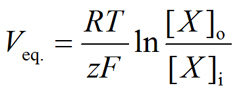
where Veq. is the equilibrium potential, R is the universal gas constant, T is the temperature in Kelvin, z is the valence of the ionic species, F is the Faraday's constant, and [X]o and [X]i are the extracellular and intracellular, respectively, concentrations of the ion in question.
See also:
Resting Membrane Potential - Nernst Equilibrium PotentialDerivation of the Nernst Equation
Definition:
Chemical messenger molecules released by neurons into the synaptic cleft.Neurotransmitter molecules may be small molecules such as glutamate, γ-aminobutyric acid (GABA), acetylcholine, dopamine, norepinephrine, serotonin (5-hydroxytryptamine), and glycine. These are referred to as classic neurotransmitters. A neuron generally releases only one type of small classic neurotransmitter.
Neurotransmitters may also be peptide molecules, such as substance P, opioids, and somatostatin. These are referred to as neuropeptides.
Gas molecules, such as nitric oxide (NO), may also act as neurotransmitters.
Definition:
Refers to cells that do not generate action potentials. With the exception of neurons, muscle cells, and some endocrine cells, all cells in the body are non-excitable.See also:
Resting Membrane Potential - IntroductionDefinition:
Refers to an abnormally low volume of urine production. Generally, a urine production rate of less than 400 mL/day is referred to as oliguria.Related glossary terms/phrases:
PolyuriaOther resources:
Oliguria (Wikipedia)Definition:
Body weight that exceeds the normal or standard weight range. The standard range is generally determined based on height and frame size.Related glossary terms/phrases:
Body Mass IndexSee also:
Body Mass Index CalculatorDefinition:
Plasma is the fluid portion of whole blood, which makes up about 40% to 60% of the total volume of whole blood. Plasma has a light yellow color and is generally obtained by separating the fluid portion from the blood formed elements through sedimentation or centrifugation. Plasma contains mostly water and, in addition, minerals, nutrients, proteins, hormones, and gases (oxygen and carbon dioxide). Unlike serum, in which fibrinogen and other clotting factors have been removed by coagulation, fibrinogen and other clotting factors remain present in plasma.Plasma is one the main fluid compartments of the human body, making up nearly 10% of the total volume of body fluids. Plasma makes up the intravascular fluid compartment; itself a subcompartment of the extracellular fluid compartment.
Definition:
Refers to an abnormally large volume of urine production. Generally, a urine production rate of higher than 2.5 L/day is referred to as polyuria.Related glossary terms/phrases:
OliguriaHypouresis
Other resources:
Polyuria (Wikipedia)Definition:
Sub-threshold (or subthreshold) refers to a stimulus that is too small in magnitude to produce an action potential in excitable cells.In general, a sub-threshold stimulus leads to the depolarization of the membrane, but the magnitude of the depolarization is not large enough to reach the threshold voltage. Therefore, sub-threshold stimuli do not elicit action potentials.
Related glossary terms/phrases:
ThresholdSupra-threshold
See also:
Neuronal Action Potential - IntroductionDefinition:
Supra-threshold (or suprathreshold) refers to a stimulus that is large enough in magnitude to produce an action potential in excitable cells.In general, a supra-threshold stimulus leads to the depolarization of the membrane, and the magnitude of the depolarization is larger than that necessary to simply reach the threshold voltage. Therefore, supra-threshold stimuli elicit action potentials.
Related glossary terms/phrases:
ThresholdSub-threshold
See also:
Neuronal Action Potential - IntroductionDefinition:
The membrane voltage that must be reached in an excitable cell (e.g., neuron or muscle cell) during a depolarization in order to generate an action potential. At the threshold voltage, voltage-gated channels become activated. Threshold is approximately −50 to −40 mV in most excitable cells.Related glossary terms/phrases:
Sub-thresholdSupra-threshold
See also:
Neuronal Action Potential - IntroductionDefinition:
Removal of approximately a pint of blood in a manner similar to that for donating blood. The procedure is generally used as a simple measure to reduce the number of circulating red blood cells (e.g., to treat polycythemia) or to reduce the amount of circulating iron (e.g., to treat hemochromatosis). The procedure may be repeated as needed.It falls under procedures referred to as phlebotomy (removing blood for therapeutic or diagnostic purposes) or bloodletting (removing blood for therapeutic purposes).
Posted: Sunday, March 31, 2013
Last updated: Friday, August 28, 2015
Last updated: Friday, August 28, 2015