 |
 |
 |
 |
 |
— share —





Electrophysiology
Definition:
Electrophysiology is the study of the electrical properties of biological macromolecules, cells, tissues, and organs. Electrical signals such as voltage and/or current are generally measured. Examples include measuring changes in the membrane voltage of excitable cells (e.g., neurons, muscle cells, and some endocrine cells) during an action potential. The current carrried by ions as they permeate the pore of ion channels can also be measured - both at the single-channel level (single-channel current), as well as the macroscopic current resulting from the activity of a population of channels. As another example, electrical measurements may involve recording voltage changes at the surface of the skin that result from the activity of skeletal muscles (electromyogram, EMG), cardiac myocytes (electrocardiogram, ECG), or neurons in the brain (electroencephalogram, EEG).Physiology
Definition:
Physiology is the study of how living systems function. The scope of physiological studies ranges from the subcellular level (molecules and organelles) all the way to the level of the whole organism and how organisms adapt to vastly different environmental conditions such as hot, cold, dry, humid, or high altitude.See also:
What is Physiology?Biconcave
Definition:
Concave on both sides of a structure, usually referring to a disc or a lens.Of particular importance to physiology is the structure of mature red blood cells (erythrocytes), which is a flattened cell that has assume a biconcave shape. It is thought that the biconcave shape of red blood cells helps with the flow property of blood through blood vessels.
Nernst equation
Definition:
An equation used to calculate the equilibrium potential (Veq.) of an ion. The equilibrium potential for an ion is also referred to as the Nernst potential for that ion. It is the membrane potential at which no net movement of the ion in question occurs across the membrane.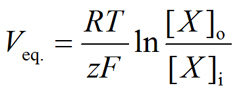
where Veq. is the equilibrium potential, R is the universal gas constant, T is the temperature in Kelvin, z is the valence of the ionic species, F is the Faraday's constant, and [X]o and [X]i are the extracellular and intracellular, respectively, concentrations of the ion in question.
See also:
Resting Membrane Potential - Nernst Equilibrium PotentialDerivation of the Nernst Equation
Posted: Sunday, March 31, 2013
Last updated: Wednesday, March 12, 2025
Last updated: Wednesday, March 12, 2025
— share —